Evaluating Caenorhabditis elegans uterine and vulval muscles as an in vivo model for actin-binding protein dysfunction relevant to Duchenne muscular dystrophy
Actin binding proteins (ABPs) regulate actin cytoskeletal organization and dynamics and are essential for muscle development, integrity, and function. Although ABP dysfunction has been implicated in muscular dystrophy (MD), most studies rely on in vitro models that fail to capture tissue interactions, disease progression, and organism-level consequences. We propose that the uterine and vulval muscles of Caenorhabditis elegans provide a simple and tractable in vivo model that complements established vertebrate models for investigating how alterations in ABPs contribute to smooth muscle dysfunction relevant to Duchenne Muscular Dystrophy (DMD). Here we focus on three conserved ABPs: dystrophin (DYS-1), which links the sarcomere to the sarcolemma to maintain the structural integrity of the muscle cell during contraction; talin (TLN-1), which connects integrins to actin filaments; and vinculin (DEB-1), which reinforces the talin-mediated linkage, allowing the muscle to transmit force to the extracellular matrix during contraction. To determine the impact of the ABPs on development, we depleted each gene using RNA interference (RNAi) and evaluated developmental phenotypes, including wild-type, bag-of-worms, sterile, and protruded vulva. Egg-laying function was assessed by calculating normalized brood size relative to the L4440 treated control strain. Depletion of TLN-1 and DEB-1 resulted in defects consistent with impaired uterine and vulval muscle function, suggesting a role for these proteins in reproductive muscle physiology. Future experiments will use fluorescence microscopy to visualize the actin organization and sarcomeric structure following ABP depletion to elucidate the cellular basis of our observed phenotypes. Ultimately, the relative similarity of C. elegans’ reproductive muscles to human smooth muscle and the conservation of cytoskeletal proteins provides a viable model for investigating how ABP dysfunction contributes to muscular dystrophy and other forms of disorders of muscle integrity.
Mentor: Dr. Rebecca Adikes
Research Lab: https://adikeslab.com/
I am incredibly grateful to have been selected to present my research at the Siena University Undergraduate Symposium. Presenting alongside talented undergraduate students was both an exciting and proud moment for me.
What made the experience even more meaningful was the opportunity to connect with other presenters, hear about their fascinating research, and learn about the theories and ideas they are exploring. Each conversation opened my mind to new perspectives and reminded me how much there is still to discover.
It was an inspiring experience—one that left me excited to keep learning, asking questions, and growing as a researcher. So much to learn, and so much more to explore!
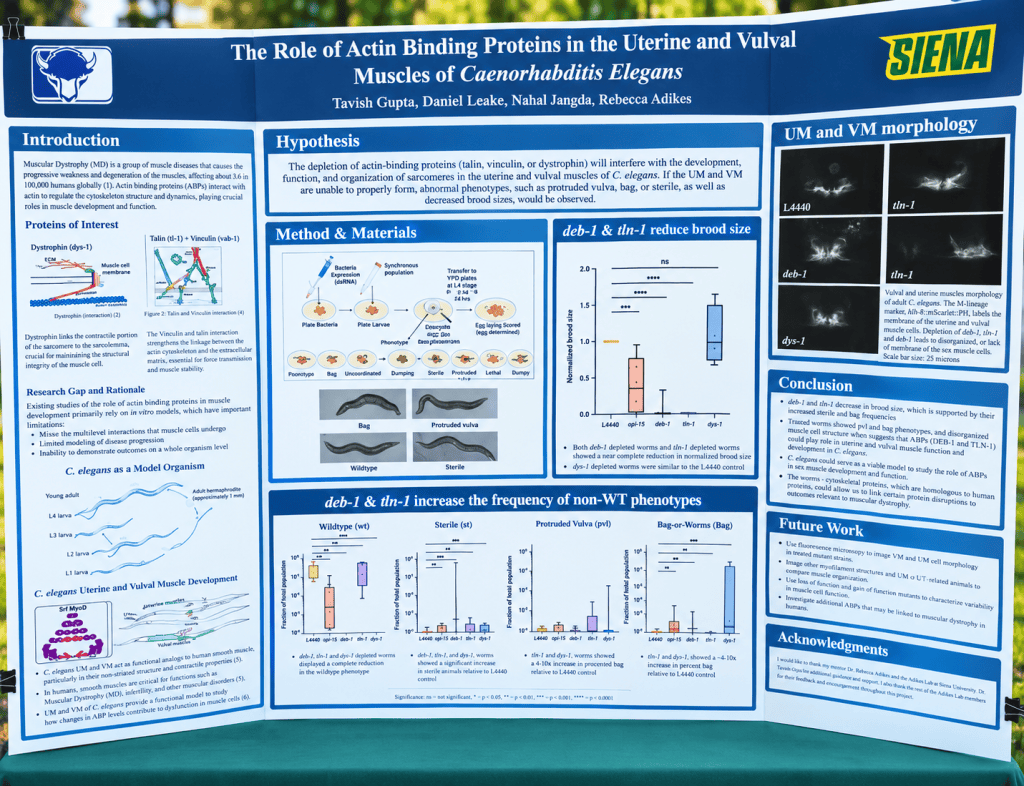
I had an exciting day presenting my science research project at the Greater Capital Region Science and Engineering Fair (GCRSEF) on March 28th 2026. After months of experimentation and analysis, and working with my mentor on “Role of Actin Binding Proteins in the Uerine and Vulval Muscles of Canorhabditis Elegans“, it was a great opportunity and rewarding experience to be selected to present at the fair.
On the day of the competition, there was a mix of excitement and nerves, but also a great sense of energy in the room. Sharing the space with like-minded students made it even more inspiring—we exchanged ideas, learned from each other, and celebrated our curiosity for science. While presenting to the judges and answering their questions, I learned to communicate my ideas clearly using simple explanations and visuals, while holding my nerves and staying relaxed.
It was truly a wonderful experience, that not only strengthened my confidence and communication skills, but also my passion and curiosity to learn about the unknowns!
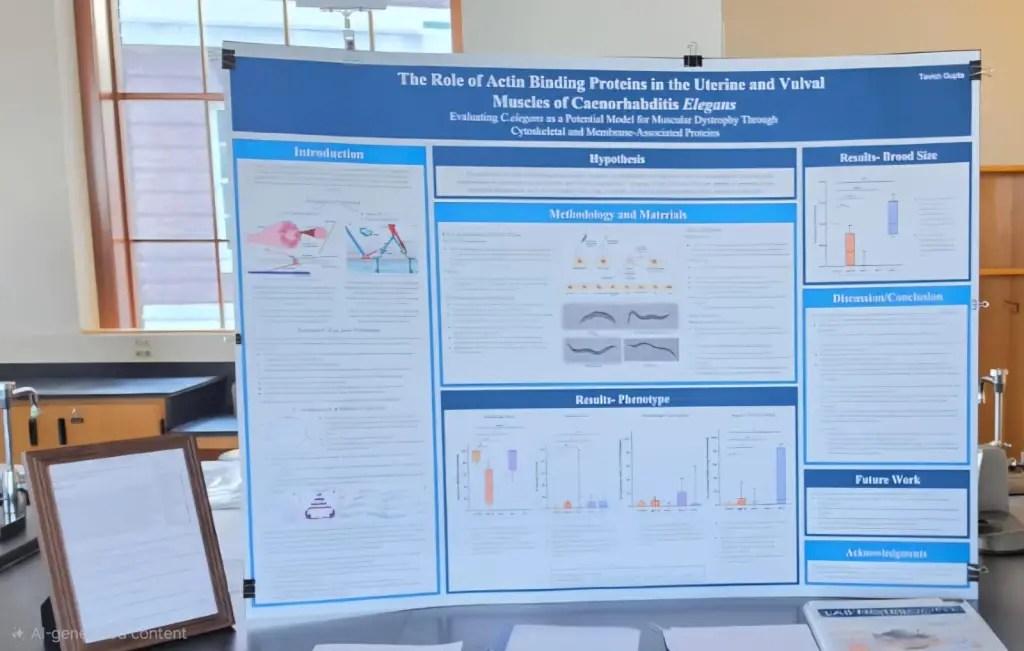
When my high school teacher told me I had been selected to present my research at the University at Albany Science Research Invitational Symposium on February 25th 2026, I was beyond thrilled. Presenting at the symposium turned out to be both an exciting and deeply rewarding experience. After dedicating so much time to developing my slides, and working closely with my teacher and mentor, it felt incredibly fulfilling to share my work with others who share the same passion for science.
At the start, I was definitely nervous—especially since I was the first presenter—but as I began speaking, I quickly found my rhythm and grew more confident. I had the opportunity to explain my research, answer thoughtful questions, and receive valuable feedback from the judges. One of the most inspiring aspects of the symposium was seeing the wide range of topics explored by other students. Being surrounded by such motivated peers gave me new perspectives and made the experience even more meaningful. I especially enjoyed discussing ideas and learning about the innovative work others had done.
Although I did not win an award—which was a bit disappointing—the experience itself was incredibly worthwhile. The feedback I received and the chance to observe other presentations taught me a great deal. It motivated me to continue refining both my research and my presentation skills.
Overall, this experience reminded me why I am drawn to science in the first place: curiosity, discovery, and the opportunity to share knowledge with others.

